Cheap vs. Good Investment: What Commercial Buyers Must Know
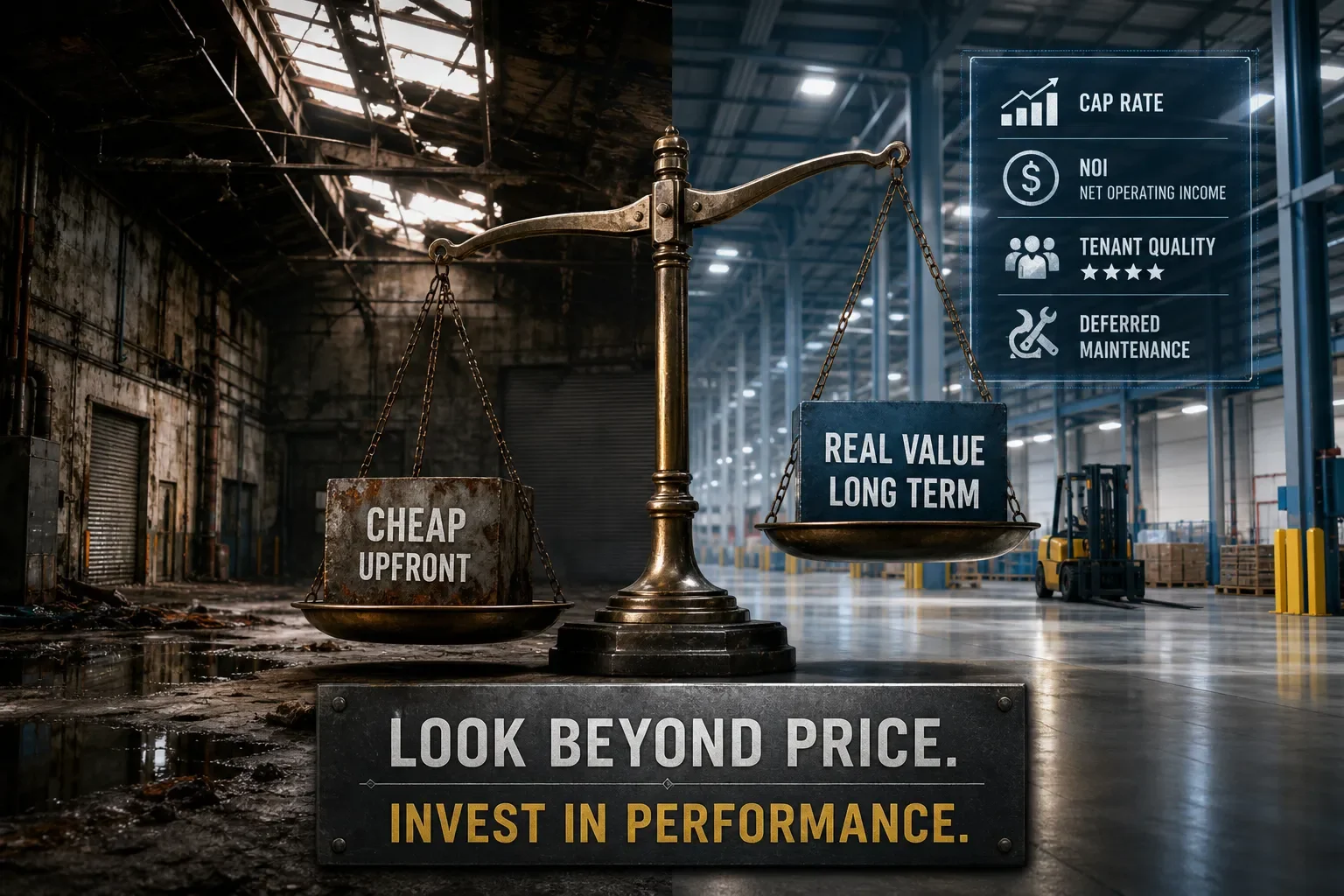
The difference between a cheap commercial property and a good investment starts well before the listing price. It lives in the financials, the physical condition, the tenant quality, and the submarket trajectory. Picture a listing in Snohomish County priced well below comparable sales in the same submarket. The square footage looks right, the location is decent, and the asking price creates an immediate pull. It feels like a deal. But a low price is not a verdict; it's an invitation to start asking harder questions. Most commercial buyers get this backwards, leading with price and working toward underwriting when the order should be reversed. That evaluation has to be built from the ground up, because the asking price is where the conversation starts, not where it ends.
This article walks through the specific metrics and red flags that separate a genuine opportunity from someone else’s problem. Careful assessment of NOI, cap rate , cash-on-cash return, vacancy history, and deferred maintenance are just the beginning of the due diligence that will tell a buyer if the deal is a boom, or a bust.
Why the asking price is the wrong starting point
Price is set by the seller. Value is determined by income, condition, and what a buyer can realistically achieve with the asset. Those are three different numbers, and they rarely align on the first read of a listing. A low-priced commercial property in a secondary market like Everett can still be overpriced if the net operating income doesn't support the purchase price.
A listing priced below market often signals at least one of these major problems: deferred maintenance, persistent vacancy, weak or short-term tenants, a zoning constraint, or environmental risk. None of those are automatic deal-breakers, but each one requires a plan and a realistic cost estimate before you can determine whether the price is actually attractive. A distressed property and a value-add opportunity are not the same thing. The distressed property has problems without a clear solution. The value-add has problems with a quantifiable path to a better return, and that path has to justify the execution risk and the capital required to walk it.
How to tell the difference between a cheap commercial property and a good investment: the financial metrics
Among the most important numbers in evaluating any commercial listing are net operating income, cap rate, and cash-on-cash return. NOI is the income figure you verify; cap rate is how you compare the property to the market; cash-on-cash return is how you assess what the deal actually does with your equity after debt service. Other metrics, operating expense ratio, CapEx reserves, LTV, and tenant concentration, round out a complete underwriting picture. These three are your first screen.
Cap rate and NOI verification
Cap rate is calculated as NOI divided by purchase price. In 2026, national averages sit around 6.1% for multifamily, 7.2% for industrial, 7.3% for retail, and 9.1% for office (per recent national cap-rate surveys and broker market reports). Locally, Snohomish County multifamily is trading in the 6.1% to 6.6% range, industrial between 5.75% and 6.75%, retail from 6.5% to 8.0%, and office from 7.5% to 10.0%, according to current Puget Sound market data.
A cap rate meaningfully above those benchmarks is not automatically attractive. It usually signals deferred maintenance, weak tenant demand, or location risk that the seller has already priced in. The critical discipline here is to verify NOI against trailing 12-month financials, not the seller's pro-forma projections, which tend to assume full occupancy, below-market expenses, and optimistic rent growth. For a buyer, it’s beneficial to look at cap rate as an expression of risk. If an asset is priced at a very low cap rate, the seller is essentially claiming that there is little to no risk on the property. For example, a fully leased up retail center with strong tenants, no upcoming expirations, and stagged rollovers. Conversely, a high cap rate signals higher risk. Multifamily with high vacancy and deferred maintenance, or a vacant single tenant retail building are good examples of assets that should carry a higher cap rate.
Cash-on-cash return and debt coverage benchmarks
Cash-on-cash measures the return you’re getting on the cash you’re putting in. Higher is better, and allows wiggle room for repairs, unexpected vacancy, etc. This rate should be compared to the “safe rate” of the cash you intend to invest. If you can get 3.5% leaving your money in the bank with no risk, you should do much better than that if you’re taking on the risk of owning rental real estate.
Debt service coverage ratio should clear 1.20x at minimum, which aligns with standard commercial lending thresholds in Washington State in 2026; anything below 1.20x becomes vulnerable to even modest rent loss or an unexpected capital item. The practical discipline is to model the property at 5% to 10% vacancy, higher-than-projected expenses, and a realistic reserve for capital expenditures. If the deal still works under those assumptions, it's worth pursuing. If it only works on the seller's best-case numbers, it isn't a deal yet.
Financing terms shape how those returns reach your equity. Higher LTV amplifies percentage returns but reduces cash-flow cushion and increases balloon risk. A property yielding 9% unlevered against 7% debt cost can work. A property yielding 6% with 8% debt destroys equity returns regardless of what the asking price looks like. Commercial loans in Washington typically mature in five to ten years while amortizing over 20 to 30 years, which creates real refinancing exposure: if values decline or NOI shrinks, you may need to bring additional equity at the worst possible moment. Low-cost commercial properties are especially vulnerable to this dynamic because transaction costs and repair needs can erode the equity cushion quickly. Whether you're pursuing a stabilized income property or an opportunistic value-add play, that refinancing risk has to be factored into your hold strategy from day one.
Location and market trajectory: the context the numbers alone can't give you
A property's income today reflects what tenants are willing to pay in that location right now. What matters for a long-term hold is whether that income is stable, growing, or under pressure. Proximity to employment centers, infrastructure investment, and population growth drives tenant demand; without those fundamentals, even strong current occupancy can deteriorate as leases roll.
In Snohomish County and North King County, industrial and multifamily have followed different demand curves than retail or office over the last several years. Industrial vacancy in Everett ran at 7.1% in early 2026, while county-wide office vacancy reached 11.3% by mid-year. Retail vacancy held around 3.4% across the county, based on Q1 and Q2 2026 market reports from regional brokerage surveys. Those numbers tell different stories about which asset types have pricing support and which carry more leasing risk going into a hold period. A property has to be evaluated by both its asset type and its specific submarket, not just by the asking price relative to a broader market average.
Look at absorption rates, new supply under construction, and rental rate trends over the prior 24 to 36 months in the specific submarket. A market where rents are growing 3% to 5% annually can support a lower current cap rate because future income will likely increase. A market where rents are flat or declining requires more income cushion today. A cheap property in a market with rising vacancy or oversupply is not a value-add opportunity; it's the early stage of a deeper problem.
What tenant quality and vacancy history actually tell you
The rent roll is often the most revealing document in a commercial transaction, and most buyers don't read it carefully enough. A property showing 90% occupancy is not the same as a stable, investment-grade asset if three of four tenants are on month-to-month leases or paying below-market rents. Current occupancy is a snapshot. Lease structure, lease duration, and tenant credit quality tell you whether that snapshot is likely to hold.
Tenant credit quality has a direct effect on value. A property anchored by a national credit tenant on a 10-year NNN lease is worth more than the same building with local tenants on short-term gross leases, even if both show identical NOI today. The credit tenant's income is more predictable, more financeable, and more durable. Also look for lease expiration concentration: if 60% of your leases expire within the same 12-month window, your refinancing risk and income risk spike simultaneously, creating a scenario where you may need to re-tenant the building right when you're trying to refinance or sell. Like many of the challenges in this article, roll-over risk is solvable, but it requires careful planning.
Vacancy history over three to five years is more useful than current occupancy. A property that cycles between 60% and 95% occupied is not a stable asset; it's a property with a recurring leasing problem. Vacancy under 5% is generally healthy; underwriting at 5% to 7% is prudent across most markets. Sustained vacancy above 7% to 10% requires a specific explanation: a physical deficiency like inadequate parking or aging mechanical systems, a location problem that limits tenant options, or a pricing issue the seller has not resolved. If the explanation is clear and the solution is quantifiable, the vacancy might represent an opportunity. If it's chronic without a clear cause, treat it as a serious warning.
Deferred maintenance and the true cost of buying cheap
Physical deficiencies are where cheap properties most often become expensive problems. In the Pacific Northwest specifically, the combination of persistent rain, temperature cycling, and older building stock means that roof, envelope, and drainage failures are the most common findings in commercial inspections. What starts as a slow leak or a patched membrane can become wet insulation, rot, interior damage, and mold remediation costs that dwarf the original repair.
Commercial roof replacement runs $5 to $30 per square foot depending on system type and building configuration. Full HVAC replacement can exceed $100,000 per system. A Phase I Environmental Site Assessment runs $2,000 to $6,000 and should be treated as a baseline requirement on any acquisition. It is the minimum standard for identifying whether environmental exposure exists. Environmental issues including underground storage tanks, asbestos, or soil contamination can range from $100,000 to several million dollars depending on scope. Beyond environmental concerns, unpermitted construction, ADA deficiencies, and open building code violations can run $50,000 to $500,000 or more to resolve, and some create legal exposure that doesn't disappear at closing. (Cost ranges reflect current contractor and consultant estimates; verify locally before underwriting.)
Recurring capital expenditure reserves vary by asset class. Multifamily typically requires $250 to $400 per unit per year. Industrial runs $0.10 to $0.25 per square foot annually for stabilized assets. Office and retail fall between those ranges. A property condition assessment, typically $5,000 to $15,000, converts physical findings into repair costs and a timeline. That report should inform your offer price or credit request, not arrive as a surprise after you've waived contingencies. The practical framework is to convert every physical finding into three figures: near-term repair cost, ongoing capital reserve, and worst-case environmental exposure. If those three numbers added to your purchase price exceed the income-supported value of the property, you're not buying cheap, you're paying full price for inherited problems.
Putting it all together before you make an offer
A reliable evaluation sequence starts with NOI verification against actual trailing financials. Then you run cap rate against comparable sales in the same submarket and asset class; if it's materially higher, you need to understand why before proceeding. From there, stress-test cash-on-cash return and DSCR at higher vacancy, higher expenses, and a realistic capital reserve. If the deal still works under those conditions, commission a property condition assessment and Phase I ESA before waiving contingencies. The cost of those reports is small relative to what they can surface.
The decision to pursue, negotiate, or walk away follows from that work. Pursue when income is verifiable, the location supports tenant demand, physical issues are quantifiable and negotiable, and the price adjusted for capital needs still produces a viable return. Negotiate when the property has real value but deferred maintenance or vacancy justifies a credit, a price reduction, or a seller-funded escrow at closing. Walk away when environmental exposure is open-ended, when vacancy reflects a structural location or physical problem without a realistic solution, or when the financing required to make the numbers work leaves no income cushion.
The difference between a cheap commercial property and a good investment is rarely visible in the listing. It lives in the submarket data, the rent roll details, the due diligence findings, and the financing structure. Serviss Commercial helps buyers across Snohomish County and North King County navigate exactly these factors: verifying income against actual financials, assessing physical risk, benchmarking cap rates against local comparable sales, and structuring offers that reflect real value rather than asking price. Buyers who skip this process don't save time or money. They inherit problems that were already priced into a listing someone else passed on.
If you're evaluating a listing and want a second set of eyes on the numbers, reach out to our team. We'll walk through the underwriting with you before you commit, so you know exactly what you're buying and what it's actually worth.